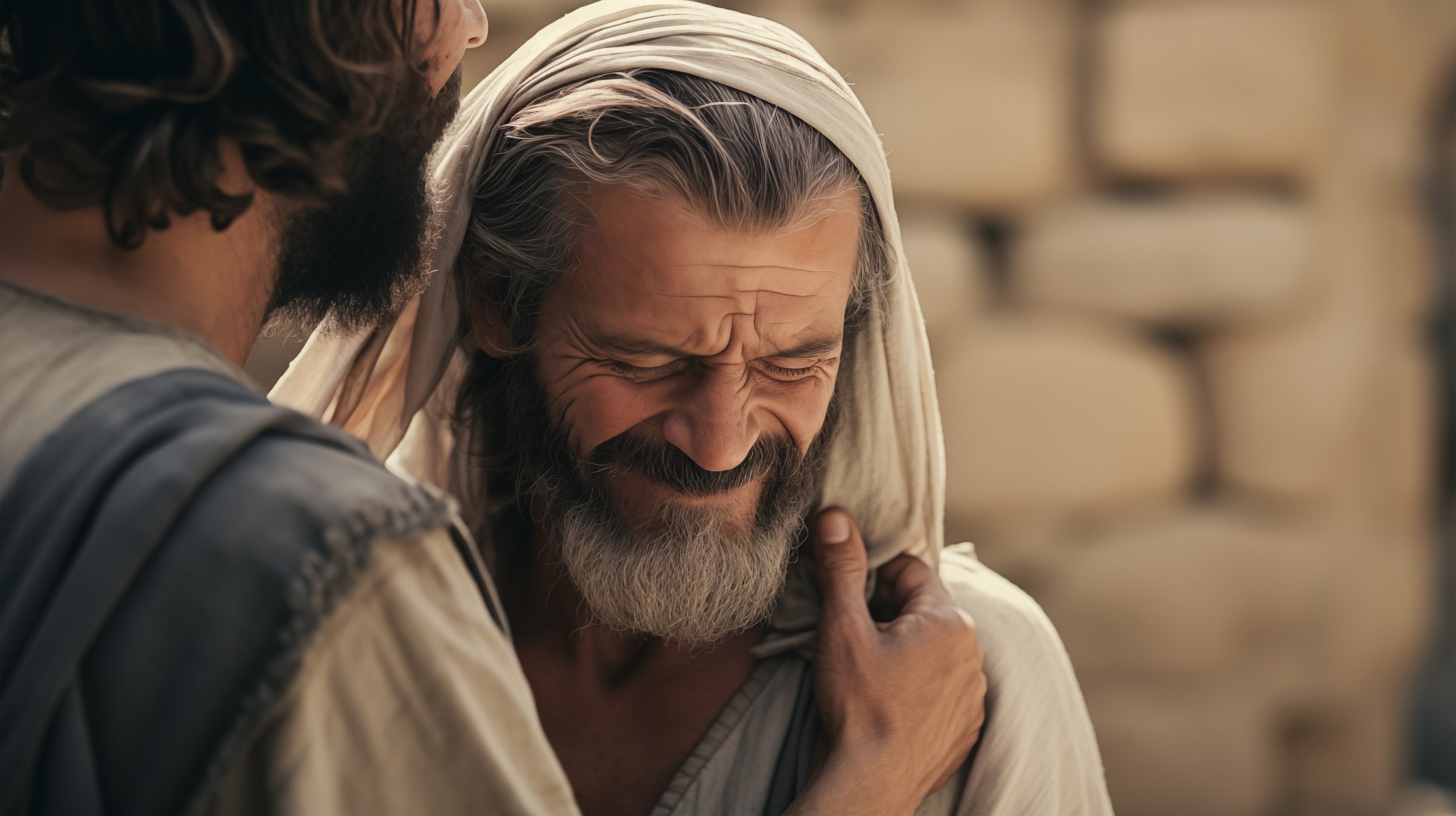


A Pitiful Man
More to the story…
The Gospel of John is different from the other three gospels. It only has 8 miraculous signs, while the others recount many. Each miracle in John is a sign illustrating the Lord’s ministry—why God became human (see John 20:30-31). Each one is part of the larger story of God’s redemption of humanity.
As with many stories of Jesus’ interaction with people, some deeper insight is needed to understand all that takes place. This one needs cultural and historical context to be understood.
The Mosaic Law and religious cultural restrictions are a major part of this story, along with Israel’s history. It revolves around a sick man lying beside the pool of Bethesda who encounters Jesus.
This man was part of a crowd gathered around the pool to receive healing. These people believed that the first person to enter the pool when an angel came from heaven and stirred up the waters would be healed.
Their hope was in a legend.
Jesus saw this man who’d been sick for 38 years and approached him with a simple question—Would you like to get well? But the man doesn’t answer Jesus directly. Instead, he gives Jesus an excuse for why he can’t be healed.
His response is the first indicator of how pitiful this man is, which becomes clearer as you read the whole story.
Scripture
Later, Jesus went to Jerusalem for a Jewish festival. Near Sheep Gate in Jerusalem was a pool called Bethesda in Hebrew. It had five porches. Under these porches a large number of sick people—people who were blind, lame, or paralyzed—used to lie.
One man, who had been sick for 38 years, was lying there. [vss 1-5]
Jesus saw the man lying there and knew that he had been sick for a long time. So Jesus asked the man, “Would you like to get well?”
The sick man answered Jesus, “Sir, I don’t have anyone to put me into the pool when the water is stirred. While I’m trying to get there, someone else steps into the pool ahead of me.”
Jesus told the man, “Get up, pick up your cot, and walk.” The man immediately became well, picked up his cot, and walked. That happened on a day of worship [the sabbath]. [vss 6-9]
So the Jews told the man who had been healed, “This is a day of worship. You’re not allowed to carry your cot today.” The man replied, “The man who made me well told me to pick up my cot and walk.”
The Jews asked him, “Who is the man who told you to pick it up and walk?” But the man who had been healed didn’t know who Jesus was. (Jesus had withdrawn from the crowd.)
Later, Jesus met the man in the temple courtyard and told him, “You’re well now. Stop sinning so that something worse doesn’t happen to you.”
The man went back to the Jews and told them that Jesus was the man who had made him well. [vss 10-15]
(John 5:1-15 GW) [Context– John 5]
Key phrase—
“Would you like to get well?”
Reflections...
Over the years, Jewish rabbis reinterpreted the fourth of the ten primary commandments of the Mosaic Law, as they did with many other supplementary laws. We see this with Jesus’ teaching in Matthew, called the Sermon on the Mount, and other places in the Gospels.
Successive interpretations over many years added restrictions to what a person could and couldn’t do on the Sabbath. These added laws distorted God’s original purpose for the Sabbath, which Jesus makes clear in other situations (see Matthew 12:1-14; Luke 13:10-17).
When Jesus spoke healing to this pitiful man, it came in the form of a command to do three things—get up, pick up his mat, and walk. So Jesus commanded the man to do something that the Jewish leaders would consider as “work” on the Sabbath.
Not long after his healing, the pitiful man is rebuked by Jewish leaders for carrying his mat as Jesus directed him to do. This puts him in a bit of a quandary, as we see in the rest of the story.
Imagine you’re this man—what would you do? Whose command would you follow? Here we see his pitiful state and weakness. He’s intimidated by the Jewish leaders and their legal requirements, and yet he’s been miraculously healed.
His response and actions show a weakness of character, especially when he makes excuses for why he can’t be healed instead of answering the Lord directly. His response to the Jewish leaders also illustrates the weakness and futility of following religious laws. Religion itself has no power to transform a person compared to God and His power.
This is a picture of Israel, who wandered in the desert wilderness for nearly forty years. Why? Because they refused to believe in God’s power to bring them into the Promised Land. They refused to accept the good report of Caleb and Joshua (see Numbers 13–14).
It comes down to where a person puts their trust. Do we trust in our own efforts to transform ourselves through religion? Or … do we trust in God Himself and His transforming power? Don’t make excuses or blame others for your circumstances—put your trust in the Lord.
Digging Deeper...
What stands out to you about the beginning of this story?
Who is gathered at this pool? Who does Jesus approach, and what does he ask this man?
How does the man respond to Jesus’ question, and why do you think he says this?
What does Jesus say to the man, and how does He say it? What takes place immediately?
Taking it to heart...
Do you understand the dilemma this man faced?
Can you see how and why this man is so pitiful?
Have you found yourself in paradoxical situations where you don’t know what to do?
Do you get caught up with what others expect of you? Do you struggle to trust God with the dilemmas of your life?
Personalize it...
Our confidence needs to be in God rather than our own efforts or religious regulations. The Lord calls us into a personal relationship of trust rather than following a rigid set of rules. God intended the Sabbath to be a restful blessing, not a restricted religious day.
As you consider present or previous dilemmas you’ve faced, ask God to give you insight and direction for how to move beyond these struggles by trusting in Him. Be honest and specific in your prayer and spend time listening and waiting for His guidance.