Discernment, Discretion and the Danger of Being Judgmental
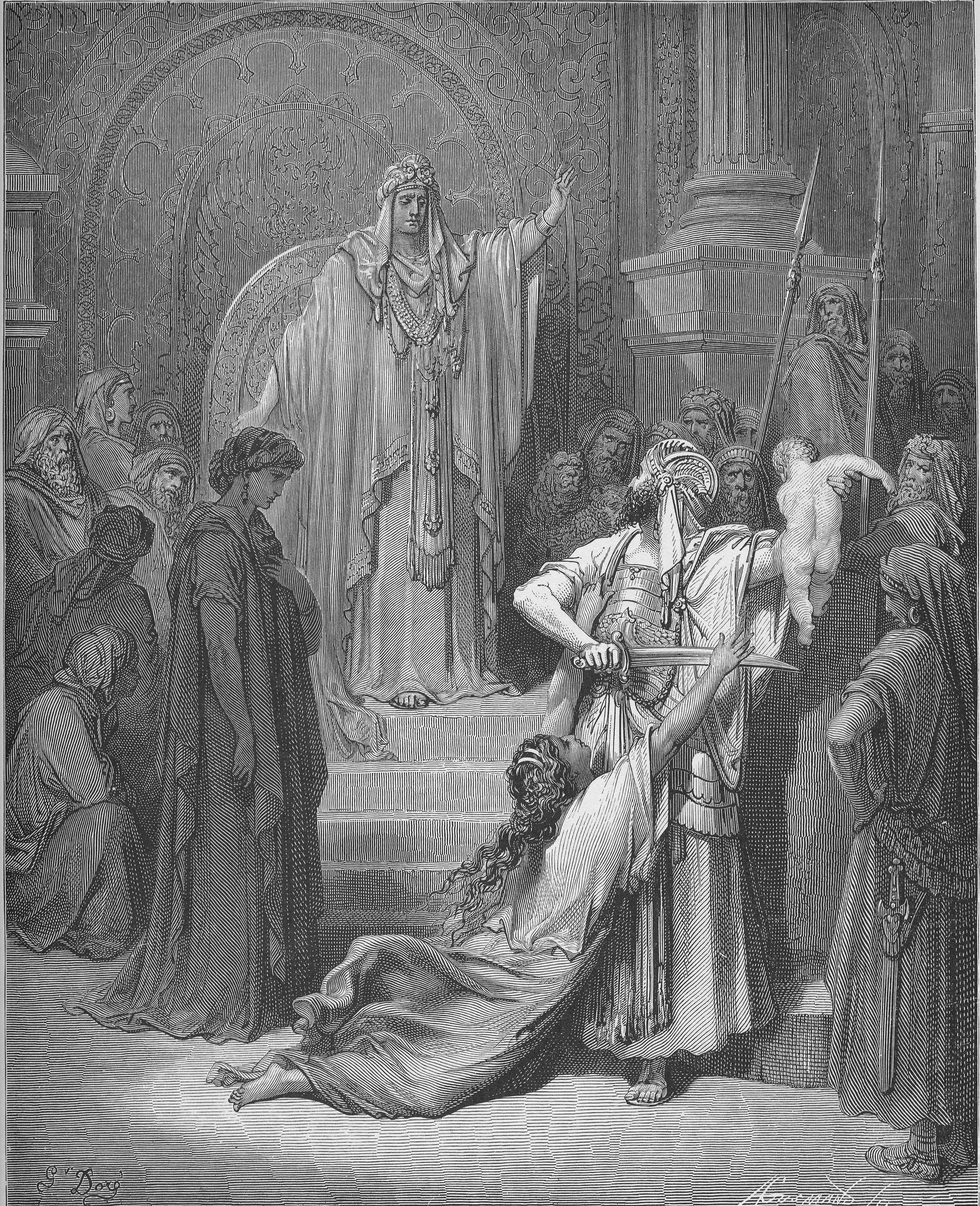
Gustave Doré, Public domain, via Wikimedia Commons (Judgment of Solomon)
“Do not judge, or you too will be judged.
For in the same way you judge others, you will be judged, and with the measure you use, it will be measured to you.” (Matthew 7:1-2 NIV84) [see full text in button/link below]
Don’t judge me!
People like to tell others, “Don’t judge me!” But we do anyway. All of us. We pass judgment on the attitudes and actions of others as if we are better than them. It’s like a plague. One we can’t escape without some help from the Lord.
We often make judgments about various events and situations with little to no credible information. We want to know who or what is to blame, whether it’s a natural disaster like Hurricane Katrina, the 9-11 terrorist attacks, or a pandemic. When something goes wrong, we are quick to find fault and assume we know how it could’ve been prevented or made right.
We are all prone to making these types of judgments, fueled by opinions, biases, and misinformation. Sadly, we perpetuate false assumptions and hasty accusations because they line up with our personal worldview. It’s easy to blame others, especially the news media, social media, and other outside influences, but we are accountable for the judgments we make. No one else.
When Christian believers disagree with prevailing cultural views, they often face harsh criticism. At times, certain Christians receive harsh condemnation for their biblical worldview. I’ve seen this too often and found myself caught up in such harsh judgments, too.
Much of the time, I hear nonbelievers criticize Christian believers with something like, “Didn’t Jesus say not to judge?” Well, He said, “Do not judge,” but followed that admonition with this one, “or you too will be judged.” Jesus also clarified what He meant by this admonition. But this clarification often goes unheeded—by all of us.
Insights
Reading through the first six verses of Matthew 7, it’s easy to make quick applications for our present time and within our own cultural worldview. But we should avoid this. Otherwise, we rush to our own judgment and reasoning and miss what Jesus says.
Jesus speaks of three different attitudes and actions in these first six verses—judgment, discernment, and discretion. Even though the definitions differ, these three words are interconnected.
The word used for judgment, especially in this context in the Sermon on the Mount, means to pronounce or pass judgment. It conveys the idea of condemnation. It’s a decision expressing an opinion of right or wrong.
Discernment has the same root meaning as judgment, but with a prefix that modifies the meaning. It can literally mean to judge through something. The idea is to distinguish one thing from another, to make a distinction.
How are the first two words different? When we judge someone, we declare our opinion of a person’s rightness or wrongness. “You’re wrong!” When we use discernment, it’s similar to the common expression, “I can see right through you!” Discernment looks more to the heart or motive of a person without passing judgment on them. In a sense, the other person condemns themselves.
Years ago, a man came to know the Lord through his son, who was our youth pastor. This man was an ex-con, so he was a little rough around the edges, but he joined in our fellowship and seemed to be growing spiritually. However, it came to our attention that he was meddling in the life of a woman in our church who was married to an unbeliever. This brother spent an inordinate amount of time “counseling” this woman about her unbeliever husband.
My assistant pastor and I went to warn this brother about his time spent with this woman. We saw it as potential for an adulterous relationship. He assured us that everything was on the up and up. We gave our warning, though he thought it unwarranted.
Not long after our warning, I learned from this woman that she had had sexual relations with the man whom we warned. So, we confronted this brother. He admitted to the adultery, but didn’t see the problem since her husband was an unbeliever and it was simply affection she needed. It stunned my assistant and me at first. Then we did what we needed to do.
Because both the man and the woman were unrepentant, I disfellowshipped them both. I made it clear that they needed to repent before they could return to our church. However, this was not the end of it. Such situations rarely resolve easily. What was perplexing was the blowback from my actions as a pastor. One couple in our church felt we didn’t go far enough and that we should have brought the man and woman in front of the church to chastise them. Another pastor friend told me I was too harsh on the man and woman who sought fellowship in his church.
The lesson I learned was simple. My assistant pastor and I had discerned the situation correctly. We handled it biblically, but graciously. Still, others felt we had not judged these two as we should have, while others felt we had judged them too harshly. I believe the Lord gave me discretion about the situation, even though not everyone agreed. Years later, the man called me up to tell me I was right in disciplining him as we had.
Sometimes we learn these truths through experience. We used discernment and didn’t judge or condemn them by reacting in a punitive way until our warning went unheeded. We used discretion by disciplining the man and woman, but were judged by others for how we dealt with the situation. Ultimately, the Lord will judge it all. The judgment seat is His alone. It’s not for you or me or anyone else.
Discretion is a combination of discernment and judgment. Judgment in the sense of reason or logic. Discernment is when we distinguish between one thing and another. Discretion is useful wisdom or a knowledgeable understanding.
Consider how Jesus speaks of these three words within these opening six verses of Matthew 7.
A True Way of Life
Jesus’ admonition not to judge others or be judgmental carries a strong consequence, “…you will be judged… with the measure you use….” The Lord will hold each of us accountable in the same way we accuse or judge others. Of course, when we’re convinced of our own rightness and blinded by pride, we are ignorant of how our judgment of others applies to us. It ought to be a reminder that judgment belongs to God. It’s His jurisdiction, not ours. God will hold all of us accountable for what we do and say. 1
Jesus clarifies and explains the hypocrisy of being judgmental. He uses an exaggerated illustration, a hyperbolic picture of how hypocritical judging others is. The “speck” in the person's eye we judge is much smaller compared to the “plank” in our own eye. The contrast isn’t between a speck and a splinter, but between a bit of sawdust and a beam that could hold up a roof.
We need to deal with our own blind spots, faults, and shortcomings first before pointing out such things in the lives of other people. It’s a lot easier to see a problem than to find a solution. But Jesus gives us the solution to being judgmental—
“You hypocrite, first take the plank out of your own eye, and then you will see clearly to remove the speck from your brother's eye.” (Matthew 7:5 NIV84)
The solution is to examine our own hearts and lives in the eyes of God, not in comparison to others. As citizens of God’s Kingdom, we are to pursue the nature of our King Jesus rather than reflect the nature of the world and its self-centered culture.
Jesus then speaks of the need for discernment and discretion. At first glance, we might wonder how being hypocritically judgmental has any connection to dogs, pearls, and pigs. Here is where we need to understand this verse from the vantage point of the time and culture of Jesus, His followers, and the Jewish religious elite.
Jesus uses the images of dogs and pigs as figures of speech. Dogs became a metaphor to personify people of evil character. Pigs were deemed unclean animals under the Law, as were dogs, and were not to be eaten. So, Jesus uses the images of dogs and pigs to represent people who were either corrupt or unspiritual in nature. There is something not right in their heart, their character, or their way of life. 2
Jesus reminds us that there are times we need to judge between right and wrong or between what is wise or foolish. This requires discernment. We need to separate what is holy from what is unholy and what is valuable from what is worthless. This requires discretion. Perhaps it will help to use an example from Proverbs—
Like a gold ring in a pig’s snout is a beautiful woman without discretion. (Proverbs 11:22 ESV)
This very descriptive picture is hard to mistake. A gold ring is too valuable to be put in a pig’s snout, and so is beauty for a woman without discretion, a woman without moral integrity, or unchaste.
In an extended story in 1 Samuel, King David is thankful for the discretion and wisdom Abigail shows when she cautions David about slaying her foolish husband for dishonoring David and his men.
And David said to Abigail, “Blessed be the Lord, the God of Israel, who sent you this day to meet me! Blessed be your discretion, and blessed be you, who have kept me this day from bloodguilt and from working salvation with my own hand!” (1 Samuel 25:32-33 ESV)
So, discernment is judging without being judgmental. It’s not at someone else’s expense and to our benefit. Discretion is knowing how to apply the understanding and wisdom gained from discernment. Each of us should be wary of judging others, especially in a judgmental way. As the apostle James wrote—
There is only one Lawgiver and Judge, the one who is able to save and destroy. But you, who are you to judge your neighbor? (James 4:12)
Discernment and discretion are helpful and useful, but the seat of judgment belongs to the Lord, not us.
Reflections for Prayer
Jesus’ admonition not to judge others or be judgmental carries a strong consequence. The same standards we use for judging others will apply to us. We need to value discernment and discretion and realize the danger of being judgmental of others.
When you find yourself being judgmental, repent! Ask the Lord for help to restore any relationships damaged by how you’ve judged others. Also, ask the Lord for the benefit of discernment and discretion. We all need a daily dose of useful wisdom. This will help you be less inclined to judge others.
Footnotes–
There are many places in the Bible that declare that we shall all be held accountable before the Lord for what we say and do in this life. Paul points this out in Romans and to the Corinthian church, and John gives us a picture of this in the Book of Revelation.
See Romans 2:16; 14:10-13; 1 Corinthians 3:13-15; 2 Corinthians 5:10; Revelation 20:11-15.
See the following Scriptures in reference to “dogs” in the context of Matthew 7:6– Psalm 22:16; Matthew 15:26; Philippians 3:2; Revelation 22:15.
See these Scriptures in reference to “pigs” in the context of Matthew 7:6– Leviticus 11:7; Deuteronomy 14:8.
This is an excerpt from a recently published book called The Heart and Soul of God’s Kingdom. Look for it on Amazon with my other books— Trip Kimball on Amazon
And you can also see some of my writing over on Substack too! Just click this link– Trip Kimball on Substack